

SERVING POST AND PRE-COLONIAL INDIGENOUS FOODS
Each country has its cultural food origins. Native American food is ours.
About Us →
About Buffalo Jump NYC
Buffalo Jump NYC is a Native American and Puerto Rican, family-owned catering company founded by Brooke Rodriguez, a Borikua Taíno New Yorker, and Chef Leo Cordier, a Sicangu Lakota from the Rosebud Sioux Reservation in South Dakota. As life partners, parents, and co-owners, they bring their cultural heritage and shared commitment to Indigenous food traditions into New York City's culinary scene.
Specializing in Indigenous North American cuisine, we combine traditional ingredients with contemporary culinary techniques. Our menus highlight bison, wild rice, heirloom corn, squash, Indigenous berries, and other foods rooted in Native American traditions.
From private gatherings to corporate events and community celebrations, we provide freshly prepared food and professional catering services.
As an Indigenous family, our mission is to preserve our culinary traditions, build a lasting family legacy, and strengthen the presence of Native American cuisine in New York City.
Our Founders →
Re-Claiming
and Re-Indigenizing
Foodways
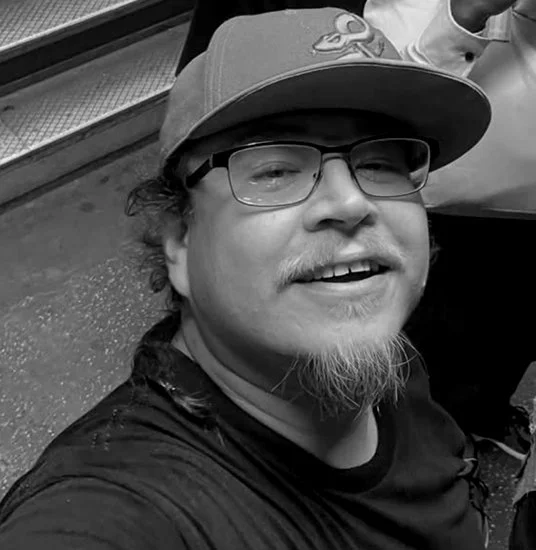
-
Chef / Co-Owner
Leo Cordier is a Sicangu Lakota dad, native cook, coding enthusiast, and co-owner of Buffalo Jump NYC.

-
Business Manager / Co-Owner
Brooke Rodriguez is a Borikua Taino Mother living in Munsee Lunape Territory, the Founder of Grinding Stone Collective an Co-owner of Buffalo Jump NYC.
OUR VISION
Buffalo Jump wants to help normalize bison again.
Our long-term goal is not simply to sell more bison dishes. We want to help build enough consumer demand to support the expansion of a Native-centered bison economy—from ranchers and processors to distributors, chefs, restaurants, and ultimately the people eating it. We want bison to become an everyday protein choice rather than something Americans think of as unusual, specialty, or reserved for a particular occasion.
In that sense, we are also trying to disrupt the dominance of the cattle, pork, and poultry industries. We want consumers to reconsider why introduced livestock became the default proteins of the United States while Indigenous food systems were displaced and marginalized.
That same philosophy extends beyond meat. Native foodways are some of the oldest foodways on this continent, yet Native people remain largely absent from the modern restaurant industry and from the way American cuisine tells its own story. Buffalo Jump exists to change that.

OUR HISTORY
The Sicangu Lakota:
The Rosebud Indian Reservation (RIR) is an Indian reservation in South Dakota, United States. It is the home of the federally recognized Sicangu Oyate (the Upper Brulé Sioux Nation) – also known as Sicangu Lakota, and the Rosebud Sioux Tribe (RST), a branch of the Lakota people. The Lakota name Sicangu Oyate translates into English as "Burnt Thigh Nation"; the French term "Brulé Sioux" is also used.
The Rosebud Indian Reservation was established in 1889 after the United States' partition of the Great Sioux Reservation. Created in 1868 by the Treaty of Fort Laramie, the Great Sioux Reservation originally covered all of West River, South Dakota (the area west of the Missouri River), as well as part of northern Nebraska and eastern Montana.
Since then, the reservation has been reduced considerably in size, as has happened with the other Sioux reservations. Today it includes only Todd County, South Dakota, and certain communities and lands in the four adjacent counties.

OUR HISTORY
What is a Buffalo Jump?
A buffalo jump is a traditional Indigenous hunting site used by Plains tribes, including the Lakota, for generations before the arrival of Europeans. These sites were strategically located near cliffs or steep terrain, where hunters worked together to guide herds of buffalo (tȟatȟáŋka) toward a drop, allowing communities to harvest the animals that sustained them.
Buffalo jumps required extensive knowledge of the land, animal behavior, seasonal movements, and coordinated community effort. They reflect the sophisticated hunting practices and ecological knowledge developed by Indigenous peoples over thousands of years.
For the Lakota and many other Plains Nations, the buffalo has long been central to survival, culture, and spirituality. Buffalo provided food, hides for clothing and shelter, bones for tools, and materials for everyday life. Every part of the animal had a purpose, reflecting a relationship grounded in respect, responsibility, and the avoidance of waste.